Collection: Chi CRAFTED - Voices of the Creators vol.3
Tamura Shogundo, Satoshi Tamura
The word karuta originates from the Portuguese term “carta,” meaning “paper card.”
Around 500 years ago, during Japan’s Muromachi period—around the same time firearms were introduced—these cards were brought to Japan by Portuguese traders. Known as Nanban karuta, they later evolved and spread widely in the form of hana karuta (flower cards).
In contrast, the game based on "Hyakunin Isshu", a collection of one hundred classical waka poems, has a different origin. It began in the early Kamakura period, when "Fujiwara no Teika" selected outstanding poems in the Saga–Arashiyama area of Kyoto. During the Edo period, advances in woodblock printing helped transform Hyakunin Isshu into a form of karuta play enjoyed not only by the aristocracy, but also by people from all walks of life.
"Tamura Shogundo" was founded in 1921 by Kumajiro Tamura, the great-grandfather of Satoshi Tamura, and has continued to preserve the art of karuta making since its establishment.
While Hyakunin Isshu karuta is often associated today with competitive karuta matches, Tamura Shogundo is dedicated to the creation of luxury karuta cards crafted entirely by hand. These refined playing cards can be seen as a crystallization of Japanese culture—traditional toys that bring together the beauty of poetry and illustration.
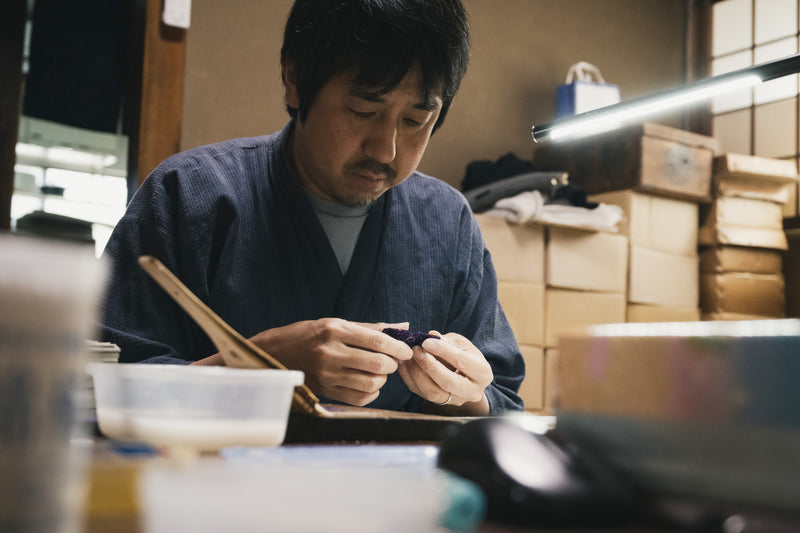
Now in its fourth generation, Satoshi Tamura is one of the very few artisans in Japan who continues to carry forward both the traditional techniques and craftsmanship behind this meticulous art, preserving it for the present day.
From its earliest days, "Tamura Shogundo" has focused primarily on the production and sale of "Hyakunin Isshu karuta".
“The peak period was during Japan’s bubble economy,” says Satoshi Tamura.
“I was still very young at the time, so this is something I heard later, but demand was so high that production couldn’t keep up. Many other makers gradually shifted to machine production.
At the same time, as video games and other forms of entertainment spread rapidly, demand for karuta began to decline.”
Afterward, Satoshi Tamura pursued a career as a corporate researcher. However, about ten years ago, his desire to ensure that the rare skills and spirit of hand-crafted karuta would not be lost grew stronger, leading him to decide to take over the family business. He went on to learn every aspect of the craft from his great-uncle, the younger brother of his grandfather.
“At first, I struggled with the feeling that such extremely fine and delicate handwork might no longer suit the times,” he recalls.
“But as I continued working carefully and patiently, I came to realize that the most meaningful way to bring joy to others is to make something truly good—to craft each and every card by hand.
Whether it is a full set of 200 cards for Hyakunin Isshu or 48 cards for hana karuta, creating each card one by one using the hands is, in fact, the most reasonable and honest approach.”

At one time, luxury karuta cards were cherished as special, almost ceremonial objects.
In recent years, however, their meaning has begun to shift gradually, influenced by the spread of social media and the growing number of international visitors to Japan.
“Some overseas visitors purchase Hyakunin Isshu karuta as objects to admire,” says Satoshi Tamura.
“But more and more people are choosing hana karuta, which can be enjoyed through the imagery even without understanding the language.
Knowing this makes me want to create something even better next time—it motivates me to devote myself even more deeply to my work.”
The workshop is arranged with separate rooms for each stage of the process, carefully designed so that Satoshi Tamura can move smoothly from one task to the next.
Perhaps it is this environment that allows him to concentrate so fully on the materials and tools in his hands.
“Before I realized it,” he says with a smile,
“I began to feel that there may no longer be anywhere else in Japan making karuta in quite the same way we do.”
As we spoke, Satoshi Tamura guided us through each step of the process behind the creation of hana karuta, sharing stories along the way.

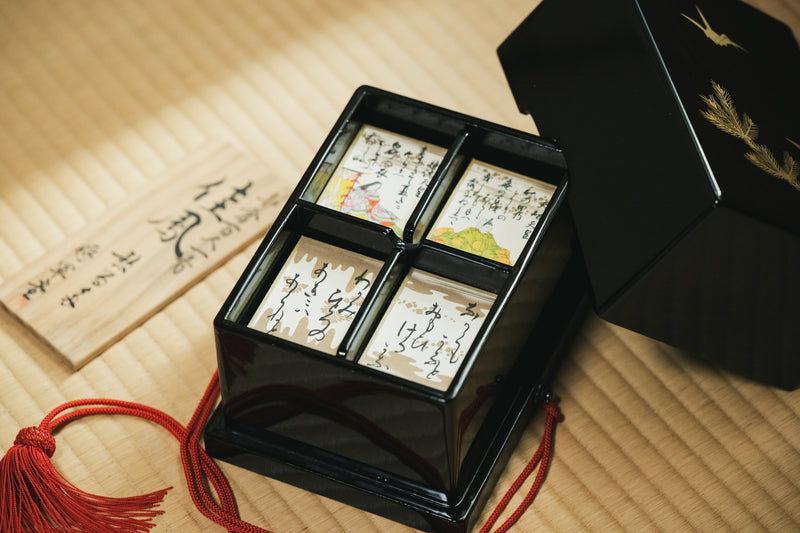
Once known as a kayoibako (circulating box), it continues to be used today across various stages of the production process and for multiple purposes.
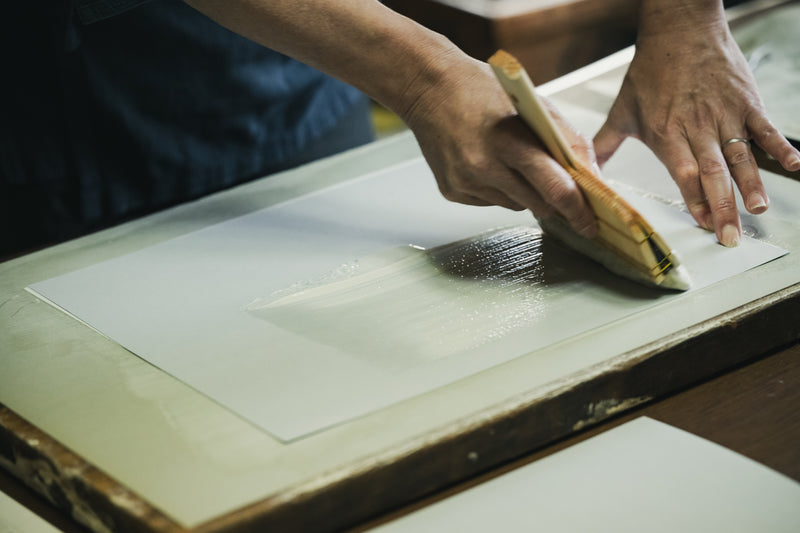
Reading the Grain of the Paper, Creating a Subtle Curve
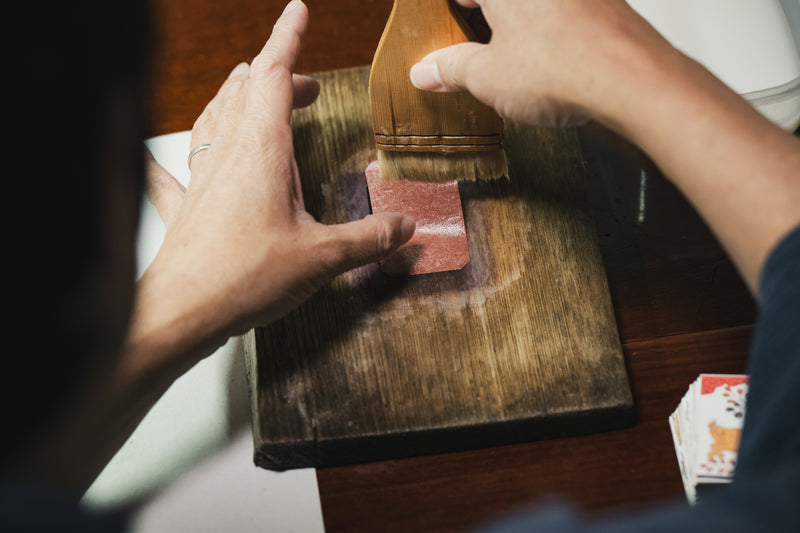
“This process is called kijihari,” explains Satoshi Tamura.
“For both hana karuta and Hyakunin Isshu karuta, we layer two or sometimes three sheets of backing paper onto the illustrated surface and carefully paste them together.
Compared to Hyakunin Isshu cards, hana karuta cards have a natural curve. Paper has a grain—fibers running in a particular direction, almost like a mesh—and by reading this grain, we subtly adjust the way the entire card will bend.
“If the card curves too much, or if it’s perfectly flat, neither is ideal,” he says.
“There is a natural, balanced degree of curvature. When the cards have this subtle bend, they are easier to gather and handle during play. These delicate nuances are extremely important, so I always pay close attention to them.”
Paper behaves almost like a living thing, changing its condition each time depending on temperature and humidity. Judging these shifts is difficult, but by layering and pasting the sheets together, the strength of the card increases dramatically.
If a card is scratched or bent, its value as karuta is instantly diminished. By firmly mounting the backing paper onto the illustrated surface, each card is finished as a sturdy, well-crafted piece—one by one.

Natural Adhesives: Techniques That Respect Living Materials
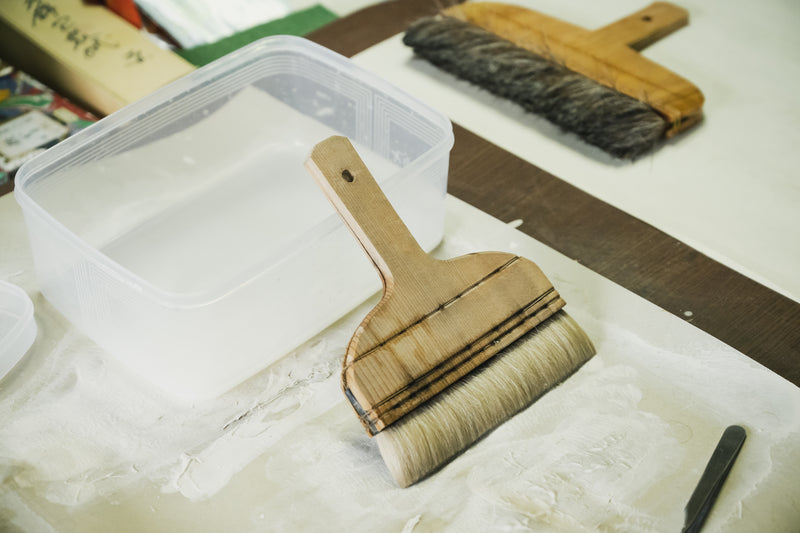
“The paste we use is made from natural starches derived from wheat and other sources,” explains Satoshi Tamura.
“It is similar to the adhesive traditionally used for mounting shoji screens in Japanese houses. When it dries, it doesn’t merely bond materials together—it naturally creates a gentle tension. This tension is essential for karuta cards, and it cannot be achieved with chemical adhesives.”
“At Tamura Shogundo, we mix (※)tonoko powder into this paste when making hana karuta,” he continues.
“This adds durability to the cards, but it also gives them a reassuring sense of weight when held in the hand.
When the cards meet during play, they produce a satisfying snap—a subtle sound that comes from this carefully balanced weight.”
(※)Tonoko is a fine powder made by crushing a special type of stone into minute particles.
It has long been used in Japan for polishing wooden objects and sword fittings, and remains an essential material in traditional craftsmanship today.

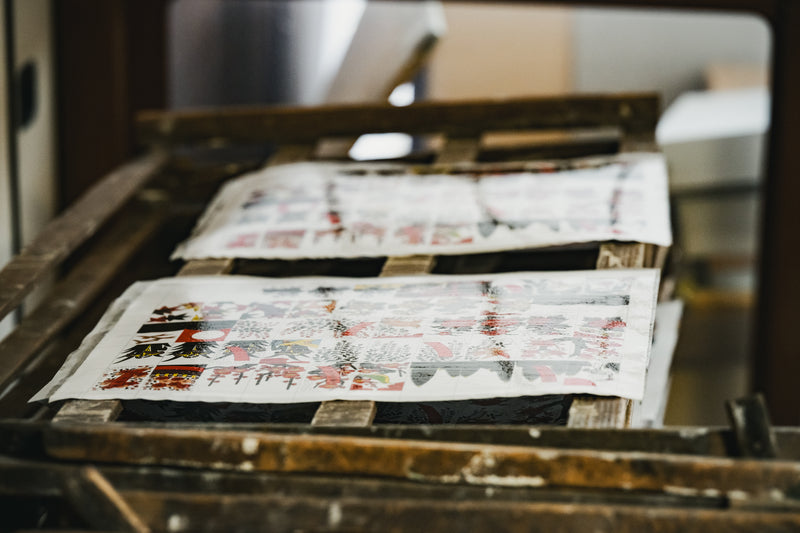
After the backing paper has been fully mounted and left to dry for two or three days, the process moves on to "uwanori", the final coating stage.
A finishing solution is carefully applied to the surface of the card.
This step also plays an important role in giving the card a sense of weight.
As the coating is applied, the colors of the design rise vividly to the surface, and a gentle sheen begins to appear.
After drying for another full day, the base of the card is finally complete.

A Brief Breath, Then a Single Motion
Cutting with Strength in the Hands and Core
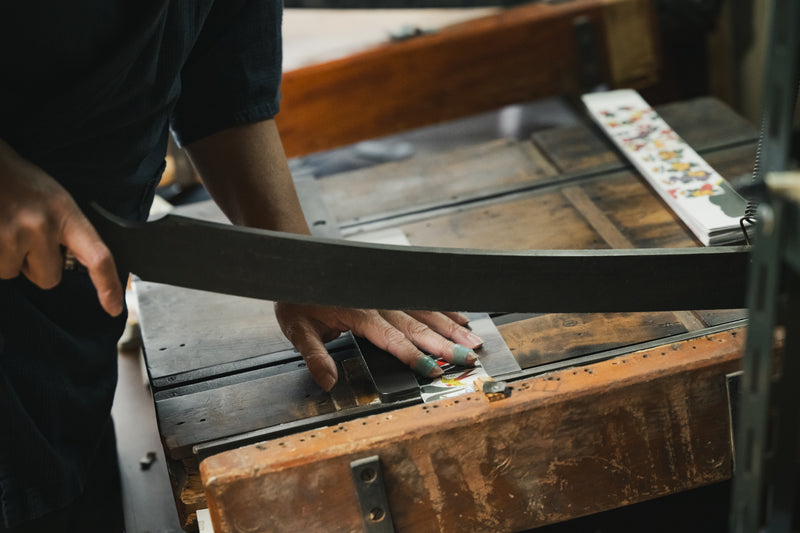
In the ōdachi cutting stage, Satoshi Tamura uses a well-worn cutting machine, steadying his breath before swiftly and manually slicing each card one by one.
The motion is instantaneous, yet precise—guided by years of experience.
“Paper expands and contracts subtly depending on its moisture content,” he explains.
“To cut cleanly along the cutting lines, vertically and horizontally, without hesitation—and to align the dimensions of every single card without the slightest deviation—is a skill that took time to master.”
Hana karuta cards are smaller than standard playing cards for a reason.
Because each card has a certain thickness, their size is carefully calculated so they sit comfortably in the hand when shuffled, making them easier to handle during play.

The backing paper of the Hana Karuta is made of washi paper dyed reddish brown (red cards) or ink color (black cards). Tamura cuts this washi paper too.
It is still not possible to handle the delicate nature of washi paper using electronically controlled cutting machines, so manual labor is the only way to make the most of the characteristics of washi paper.
"In the finishing process, the backing is pasted onto the fabric, but because it is a very thin paper, it is difficult to cut and to apply the glue with the right amount of pressure."

As If Wrapping, One Card at a Time
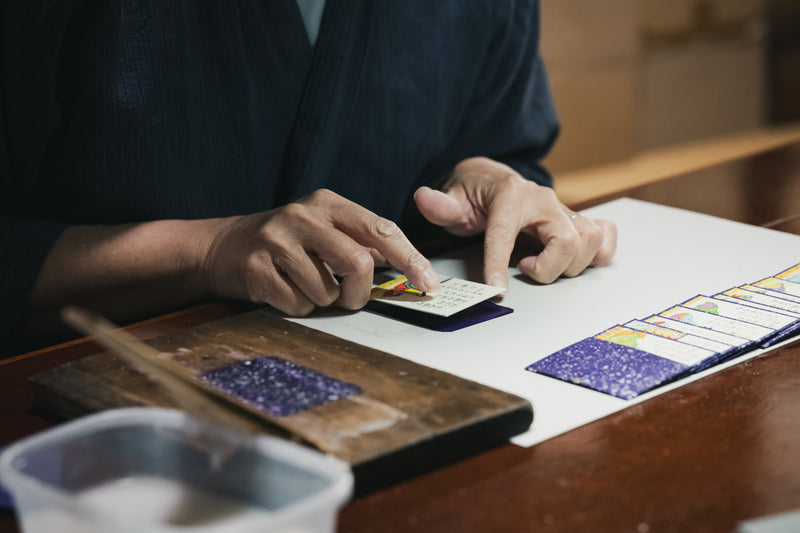
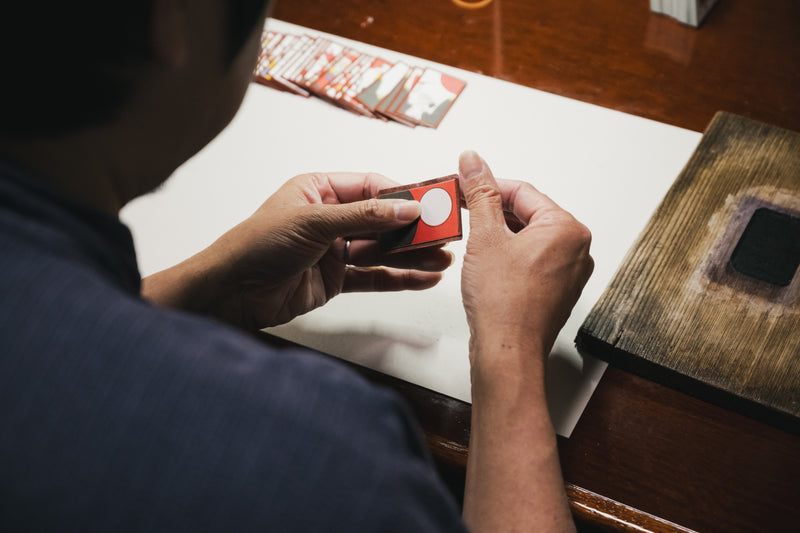
“To avoid damage, each card is carefully assembled one by one,” says Satoshi Tamura.
“I gently wrap the base with my hands, then fold and finish the four corners.”
For hana karuta, this process is repeated 48 times; for Hyakunin Isshu, 200 times.
Even with experience, the work takes several hours, making it one of the most demanding stages of production.
Once complete, the illustrated cards are laid out and inspected in detail.
Only then are Tamura Shogundo’s traditionally handcrafted karuta sets finished.
Whether hana karuta or Hyakunin Isshu—48 cards or 200—each and every card is created with unwavering focus by the hands of a master.
In karuta, the game cannot exist if even a single card is missing.
In that sense, every card is both a leading presence and an indispensable supporting one.
Watching Satoshi Tamura craft each card with care and quiet devotion, one cannot help but feel the depth and precision of his handwork.

Texture, Sheen, Luster, Color, and the Ideal Firmness
Where Handcraftsmanship Brings Everything to Life
Natural materials such as paste and paper are handled with familiar tools, each process carried out individually, without sparing time or effort.
What may feel like an entirely natural set of gestures to Satoshi Tamura has become increasingly rare in Japan today—few now continue to inherit and practice this way of working by hand.
“I’ve never thought of what I do as something special, or of the karuta I make as being somehow more ‘authentic’ than others,” he says.
“I’ve simply pursued what I believe to be truly good.
Toys and games rooted in traditional culture naturally change as times change—the same is true of how they are made.
Still, the feel of each card in the hand—the texture, sheen, luster, richness of color, and the ideal degree of firmness—along with the sound made when cards strike one another, or how they settle in the palm, are subtle sensations that can never be reduced to numbers.
I believe these are universal values. And that exquisite balance can only be achieved through handcraft.”

You can watch a production demonstration by Tamura Shogundo's Satoshi Tamura.
Dates: January 7th (Wed) - 9th (Fri), 2026
<Demonstration time: 10:30-17:30>
*Please note that the performance time may be subject to change.
Location: Kyoto Museum of Crafts and Design
Paid (admission fee required)
Adults (including university students): 500 yen
Kyoto Museum of Crafts and Design Admission Fees
Museum Craftsman Demonstration Schedule

-
Hyakunin Isshu Kahō Karuta(Handwritten Semi-Cursive and Cursive Script) / no.3013
Regular price $834Regular priceUnit price / perSale price $834 -
Hyakunin Isshu – Premium Paulownia Box / no.0120
Regular price $163Regular priceUnit price / perSale price $163 -
Hyakunin Isshu – Selected Edition / no.1215
Regular price $53Regular priceUnit price / perSale price $53 -
Hanakaruta Shishinden Black/ no.1216-b
Regular price $30Regular priceUnit price / perSale price $30 -
Hanakaruta Maiko Hanafuda (red card)
Regular price $30Regular priceUnit price / perSale price $30 -
Hanakaruta Maiko Hanafuda (black cards)
Regular price $30Regular priceUnit price / perSale price $30 -
Hanakaruta Shishinden Red / no.1216
Regular price $30Regular priceUnit price / perSale price $30